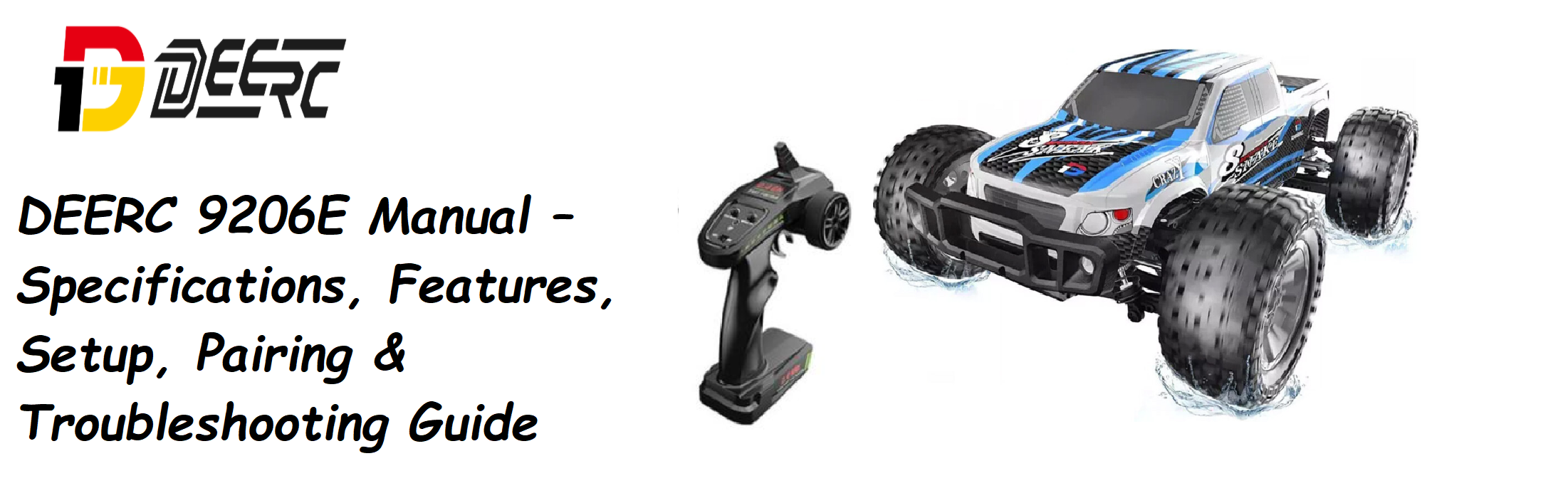

DEERC 9206E Manual – Specs, Features, Setup & Troubleshooting Guide
Introduction
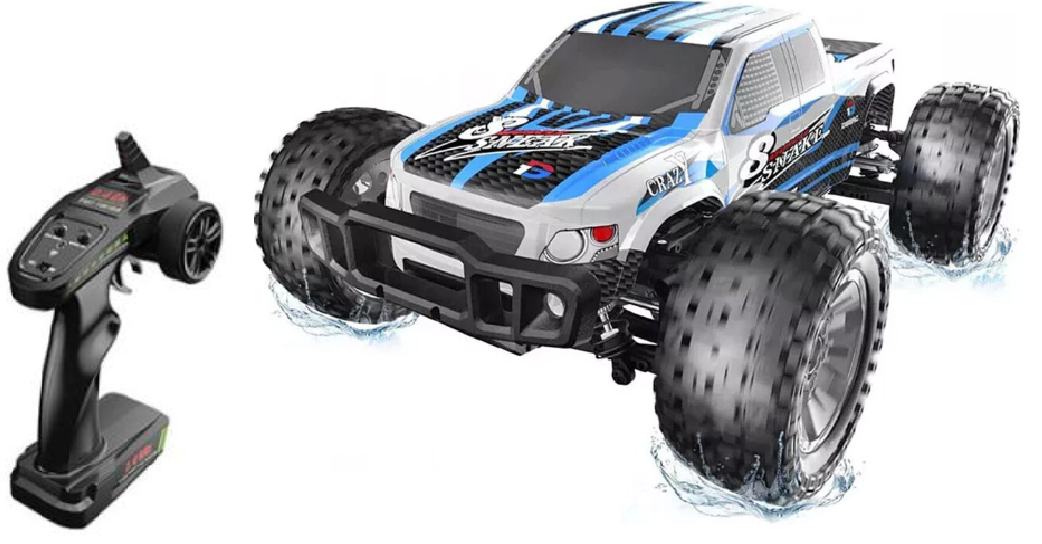
The DEERC 9206E is a 1:12 scale remote control truck that’s ready to run out of the box. It’s popular with beginners and kids because it’s fast, durable, and easy to control. The box includes the car, a 2.4GHz transmitter, two batteries, a USB charger, and a small instruction sheet. Many new owners search for a “DEERC 9206E manual” because they need help understanding the steering trim, binding the controller, or troubleshooting a car that won’t move. This guide covers every specification, feature, and common fix — in plain, practical language.
Full Specifications
| Specification | Detail |
|---|---|
| Model | 9206E |
| Scale | 1:12 |
| Motor | Brushed 390 motor |
| Top Speed | Approx. 30 km/h (18 mph) |
| Control System | 2.4 GHz radio (allows multiple cars to race without interference) |
| Control Range | Up to 80 metres (260 feet) in open space |
| Battery (Car) | 7.4V 1500mAh Li‑Ion rechargeable battery (proprietary connector) |
| Run Time | Up to 20 minutes per charge (varies with driving style) |
| Charge Time | About 2–3 hours via USB |
| Battery (Transmitter) | 2 × AA batteries (not included) |
| Chassis | Independent suspension, oil‑filled shocks, metal drive shafts, all‑terrain tyres |
| Steering Trim | Adjustable on the transmitter (keeps the car driving straight) |
| Water Resistance | Splash‑resistant (not fully waterproof) |
| Dimensions | 36 × 23 × 14 cm (14.2 × 9.1 × 5.5 inches) |
| Weight | 1.3 kg (2.9 lbs) with battery |
| Colour | Blue/Orange (varies by listing) |
| In‑the‑Box | 1 x RC car (battery pre‑installed), 1 x 2.4GHz transmitter, 1 x 7.4V Li‑Ion battery, 1 x USB charger, 1 x screwdriver, 1 x instruction leaflet |
Key Features at a Glance
- 2.4GHz Anti‑Interference: You can race multiple 9206E cars side by side without signal crossover. The car and transmitter bind automatically when both are powered on.
- Independent Suspension & Oil‑Filled Shocks: The four‑wheel independent suspension and metal‑capped oil shocks absorb bumps and small jumps, making it suitable for grass, gravel, and pavement.
- Proportional Throttle & Steering: The transmitter gives precise control — you can drive slowly or at full speed, and steer gradually rather than just hard left or right.
- Steering Trim Dial: A small dial on the transmitter lets you adjust the centre point of the steering. If the car pulls to one side, turn the dial until it drives straight.
- All‑Terrain Tyres: The large, knobby rubber tyres grip dirt, short grass, and asphalt well. The wheels are durable and absorb impact.
- Metal Drive Shafts & Gears: Unlike many toy‑grade cars, the 9206E uses metal drive shafts and differential gears, which extend the car’s lifespan under hard use.
What’s Inside the Box
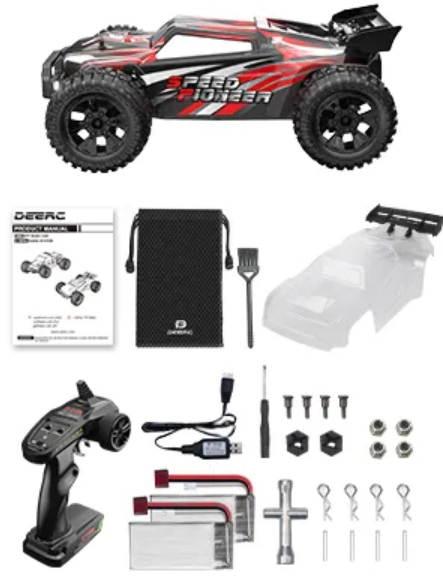
- DEERC 9206E RC truck (battery pre‑installed inside the car, connected to the ESC)
- 2.4GHz pistol‑grip transmitter (requires 2 × AA batteries, not included)
- Spare 7.4V 1500mAh Li‑Ion battery (some bundles include two batteries; check your listing)
- USB charger cable (USB‑A to proprietary connector)
- Small Phillips screwdriver (for battery compartment and adjustments)
- Instruction leaflet
The car’s battery may arrive partially charged. It’s good practice to charge it fully before the first run.
First‑Time Setup and Binding
- Insert AA batteries into the transmitter. Open the battery cover on the bottom of the transmitter and install two fresh AA batteries, matching the polarity marks. The transmitter’s LED will blink slowly or remain off until you turn it on.
- Charge the car’s battery. Connect the USB charger to a standard USB‑A power source (phone charger, power bank, or computer USB port). Connect the other end to the battery. The charger LED glows red while charging, and turns green when fully charged. A full charge takes about 2–3 hours. Always unplug the battery once fully charged.
- Install the battery in the car. The battery compartment is under the chassis. Slide the latch to open the cover. Connect the battery to the car’s ESC (Electronic Speed Controller) plug — match the connector shape. Tuck the battery and wires inside and close the cover securely.
- Turn on the transmitter. Slide the power switch on the transmitter to On. The LED will blink.
- Turn on the car. There’s a small power switch on the car (usually on the bottom or side, near the battery compartment). Flip it to On. The car’s ESC will beep once, and the transmitter’s LED will turn solid — this means they are bound. The car is now ready to drive.
Understanding the Transmitter Controls
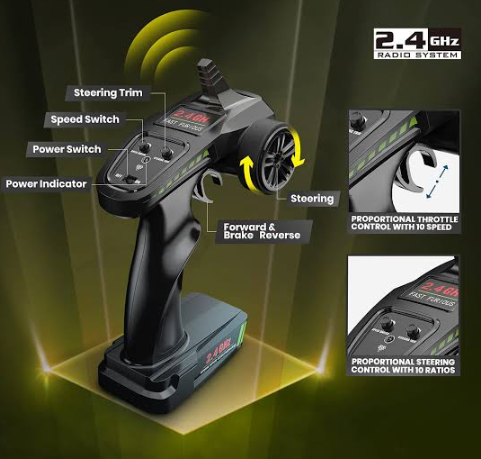
- Throttle Trigger (index finger): Pull back to accelerate forward. Push forward to brake, then push again for reverse (double‑tap for reverse is normal on many ESCs). The car will stop when the trigger is in the neutral (centre) position.
- Steering Wheel (thumb): Turn left to steer left, right to steer right. The wheel is proportional — small turns give gentle steering, full turns give tight corners.
- Steering Trim Dial (small round knob near the steering wheel): If the car veers left or right when you’re driving straight, adjust this dial. Turn it toward the direction the car is pulling (e.g., if the car pulls left, turn the dial right until the car drives straight).
- Power Switch (on the transmitter body): Slide to turn on/off. The LED glows solid when connected.
Driving, Terrain, and Battery Tips
- Start slow. The car is fast. Begin with gentle throttle and steering inputs until you’re comfortable.
- Terrain: The 9206E handles short grass, dirt, gravel, and pavement well. Avoid deep water, mud, and sand — they can damage the motor and bearings.
- Avoid running the battery to zero. When the car slows noticeably, stop and recharge. Over‑discharging a Li‑Ion battery can damage it permanently.
- Let the motor cool between runs. After a 20‑minute run, let the car rest for 10–15 minutes before swapping batteries. This prevents overheating.
Troubleshooting Common Issues
| Problem | Likely Cause | What to Try |
|---|---|---|
| Car won’t move | Battery dead, or connection loose | Recharge the battery. Check that the battery connector is firmly plugged into the car’s ESC. Turn both the car and transmitter off, then on again. |
| No steering / no throttle | Transmitter not bound, or AA batteries low | Replace AA batteries in the transmitter. Turn the car off, turn the transmitter off, then turn the transmitter on first, then the car. |
| Car pulls to one side | Steering trim off | Adjust the steering trim dial on the transmitter until the car drives straight. If the problem persists, check for a bent tie rod or debris in the steering linkage. |
| Short run time | Battery not fully charged, or old battery | Charge the battery until the charger LED turns green. If run time is consistently under 10 minutes, the battery may be worn — consider a replacement. |
| Wheels spin but car doesn’t move on the ground | Slipped pinion gear or stripped wheel hex | Remove the wheel and check the plastic hex hub inside the wheel. If it’s rounded, replace the wheel or the hex. Check that the motor pinion gear is tight on the motor shaft. |
| Car stops working after a small bump | Loose battery connection | Open the battery compartment and ensure the battery plug is pushed all the way into the ESC connector. A small bump can unseat a loose plug. |
| Transmitter LED blinks rapidly and won’t connect | AA batteries very low, or binding lost | Replace the transmitter batteries. Turn both the car and transmitter off, wait 10 seconds, then turn on the transmitter first, then the car. |
How to Reset and Re‑Bind
Soft reset: Turn off the car and the transmitter. Wait 10 seconds. Turn on the transmitter, then turn on the car. They will re‑bind automatically.
Re‑binding (if the car no longer responds to the transmitter):
- Turn off both the car and the transmitter.
- Turn on the car. Within 5 seconds, turn on the transmitter.
- The transmitter’s LED will blink while searching, then turn solid when bound. If it doesn’t bind, repeat the process — sometimes turning on the car first, then the transmitter, works better.
No factory reset needed. The simple power‑cycling process above restores the connection.
Quick Reference Card
| Task | How |
|---|---|
| Bind car and transmitter | Turn on car, then turn on transmitter |
| Adjust steering trim | Turn the small dial on the transmitter until car drives straight |
| Recharge battery | Connect to USB charger; LED on charger turns green when full |
| Check AA batteries in transmitter | Transmitter LED blinks slowly when batteries are low |
| Clean the car | Use a soft brush and damp cloth; do not hose down |
Official DEERC Support and Manuals
For warranty, replacement parts, and the official manual, contact DEERC via the platform where you purchased the car, or visit their support page if available.
Frequently Asked Questions
- Can I use the car in the rain or through puddles?
The car is splash‑resistant but not waterproof. Light damp grass is okay. Avoid standing water and heavy rain — water can damage the ESC and motor. - How long does the battery take to charge?
About 2–3 hours from empty. The USB charger LED will turn from red to green when fully charged. Always unplug the battery once charged. - Can I buy spare batteries?
Yes, search for “DEERC 7.4V 1500mAh” or similar Li‑Ion batteries with the same connector. Ensure the voltage and connector type match. - What do the different beeps mean when I turn the car on?
A single beep usually means the ESC is powered and ready. A rapid beeping without movement often means the battery is low or the connection is loose. - The car drives forward but has no reverse. Is it broken?
No. Many hobby‑grade ESCs require a double‑tap of the throttle trigger to engage reverse (first push to brake, second push to reverse). This protects the gears. - Why does the steering trim need adjusting every time I drive?
Small bumps can shift the steering linkage slightly. It’s normal to tweak the trim dial at the start of each session. If you’re constantly adjusting it, check for a loose screw on the steering assembly. - Can I upgrade the battery for longer run time?
You can use a higher‑capacity 7.4V Li‑Ion battery with the same connector, but ensure it fits in the battery compartment. A larger battery may add weight and affect handling. - What should I do if the car’s range seems short?
Replace the AA batteries in the transmitter. Low transmitter batteries reduce range significantly. Also avoid driving near large metal objects or Wi‑Fi routers. - How do I replace a broken wheel or tyre?
The wheels are attached with a screw in the centre (under the decorative hub cap). Remove the screw, pull the wheel off, and install a new wheel. Replacement wheels are sold by DEERC and third‑party retailers. - The motor gets very hot. Is that normal?
Brushed motors get warm during use. If it’s too hot to touch, let the car cool down before running again. Continuous high‑speed driving on grass can overheat the motor quickly. - Can I use the car indoors?
Yes, on smooth floors. It’s fast, so clear fragile items out of the way. The tyres provide decent grip on hardwood and tile. - The car is making a grinding noise. What is it?
It’s likely the pinion gear (attached to the motor) slipping against the spur gear. Open the gear cover and check that the pinion is tight on the motor shaft and the gears are not stripped. Replace if needed.
Other Manuals You May Like
If this guide was helpful, here are a few more popular manuals from productsmanuals.com that you might find useful:
- iPhone 17 – Settings, Camera & Hidden Features Manual
Master Dynamic Island, Action button, and battery‑health tricks. - Samsung Galaxy S24 Ultra – S Pen, Galaxy AI & Pro Camera Guide
Get the most from the 200 MP sensor, Circle to Search, and DeX mode. - Logitech K380 – Multi‑Device Bluetooth Keyboard Setup & Key Fixes
Pair three devices, fix stuck keys, and master function shortcuts.
Browse all guides at productsmanuals.com .
Copyright Warning ⚠
Copyright 2026 productsmanuals.com All rights reserved. This DEERC 9206E manual is original content and may not be copied, republished, or redistributed without written permission. DEERC and the DEERC logo are trademarks of their respective owners. This guide is unofficial and not affiliated with DEERC.
