
Rotenso TA26Xi R17 Series Room Air Conditioner
INTRODUCTION
The Rotenso TA26Xi R17 TETA X Series Room Air Conditioner delivers efficient cooling and heating performance for modern residential spaces. Designed with advanced inverter technology, the unit provides stable temperature control, reduced energy consumption, and quiet operation for maximum comfort throughout the year.
The sleek wall-mounted indoor unit features intelligent airflow management, a modern LED display, and user-friendly remote control functions. Its energy-efficient system helps maintain optimal indoor climate conditions while minimizing electricity costs. The TA26Xi R17 model also supports automatic restart functionality, sleep mode, timer programming, and fast cooling performance.
Built with reliable R32 refrigerant technology, the Rotenso TETA X Series offers environmentally friendly operation and enhanced thermal efficiency. The washable air filtration system improves indoor air quality by reducing dust and airborne particles, making the unit suitable for homes, apartments, offices, and small commercial spaces.
With durable construction, low-noise performance, and smart climate control features, the Rotenso TA26Xi R17 air conditioner combines comfort, efficiency, and reliability in a compact modern design.
PRODUCT SAFETY INFORMATION
Warning
Only qualified personnel should install and service the equipment. The installation, starting up, and servicing of heating, ventilating, and air-conditioning equipment can be hazardous and requires specific knowledge and training. Improperly installed, adjusted or altered equipment by an unqualified person could result in death or serious injury. When working on the equipment, observe all precautions in the literature and on the tags, stickers, and labels that are attached to the equipment.
UTILIZATION:
Do not dispose of this product together with unsorted municipal waste. It’s necessary to transfer this type of waste for special processing. It’s illegal to throw the device together with other household waste. There are several ways to get rid of this type of equipment:
- . The city organizes electronic waste collection, you can pass the device without the cost.
- . When you buy a new device the seller will accept the old device without any fees.
- . Manufacturer will take the product from buyer product without charging it with costs.
- . Products of this type, contains valuable elements,
it can be sold sprzedane on purchase of metals.
 Throwing the device ,,on wild” exposes you to the risk of losing your health. Dangerous substances from the device can penetrate to groundwater creating a danger of getting through to people’s food chain.
Read the following if you use the device in European countries:
The device can not be operated by children under 8 years old, disabled people and oraz people without experience and knowledge. Instructions should include a description of the correct and safe handling of the device and oraz information about possible dangers. Children should not play with the device. Cleaning and servicing should be carried out by authorized persons.
INTRODUCTION TO REFRIGERANTS R32
The refrigerants used for air conditioners are environmentally friendly hydrocarbons R32. The two kinds of refrigerants are combustible and odorless. Moreover, they can bum and explode under certain condition. However, there will be no risk of burning and explosion if you comply with the following table to install your air conditioner in a room with an appropriate area and use it correctly.
Compared with ordinary refrigerants, Refrigerants R32 is environmentally friendly and do not destroy the ozone sphere and that their values of greenhouse effect are also very low. Detailed parameters and information about purchased unit can be found in the product fiche attached to the device (i.e. type and charge amount of refrigerant, global warming potential, CO2 equivalent).
PRECAUTIONS
WARNING
- Please read the manual before installation, using, maintenance.
- Do not use means to accelerate the defrosting process or to clean, other than those recommended by the manufacturer.
- Do not pierce or bum the appliance.
- The appliance shall be stored in a room without continuously operating sources (for example: open flames, an operating ignition gas appliance or an operating electric heater.)
- Please contact the nearest after-sale service center when maintenance is necessary. At the time of maintenance, the maintenance personnel must strictly comply with the Operation
- Manual provided by the corresponding manufacturer and any non-professional is prohibited to maintain the air conditioner.
- It is necessary to comply with the provisions of gas-related national laws and regulations.
- It is necessary to clear away the refrigerant in the system when maintaining or scrapping an air conditioner.
 IMPORTANT NOTE
Read the user manual, installation manual and service manual carefully before installing or operating your new air conditioning unit.
WARNING: Risk of fire/flammable materials (Required for R32/R290 units only)
SAFETY RULES AND RECOMMENDATIONS FOR THE INSTALLER
CAUTIONS
- Read this guide before installing and using the appliance.
- Make sure that the base of the outdoor unit is firmly fixed.
- Carry out a test cycle after installing the air conditioner and record the operating data.
- Check that the socket is suitable for the plug, otherwise have the socket changed.
- The appliance must be installed in accordance with applicable national regulations.
- Before accessing the terminals, all the power circuits must be disconnected from the power supply.
- During the installation of the indoor and outdoor units the access to the working area should be forbidden to children.
- Unforeseeable accidents could happen.
- The user must protect the indoor unit with a fuse of suitable capacity for the maximum in put current or with another overload protection device.
- The ratings of the fuse installed in the built in control unit are T 5A / 250V.
- The air conditioner must be installed by professional or qualified persons.
- Check that air cannot enter the refrigerant system and check for refrigerant leaks when moving the air conditioner.
- Ensure that the mains voltage corresponds to that stamped on the rating plate. Keep the switch or power plug clean. Insert the power plug correctly and firmly into the socket, thereby a voiding the risk of electric shock or fire due to insufficient contact.
- If the appliance gives off smoke or there is a smell of burning, immediately cut off the power supply and contact the Service Centre.
- The appliance must be fitted with means for disconnection from the supply mains having a contact separation in all poles that pro vide full disconnection under overvoltage category III conditions, and these means must be incorporated in the fixed wiring in accordance with the wiring rules.
- Do not install the appliance at a distance of less than 50 cm from inflammable substances (alcohol, etc.) Or from pressurised containers (e.g. spray cans).
- If the appliance is used in areas without the possibility of ventilation, precautions must be taken to prevent any leaks of refrigerant gas from remaining in the environment and creating a danger of fire
- The packaging materials are recyclable and should be disposed of in the separate waste bins . Take the air conditioner at the end of its useful life to a special waste collection centre for disposal.
- Only use the air conditioner as instructed in this booklet. These instructions are not intended to cover every possible condition and situation.
- As with any electrical household appliance, common sense and caution are therefore always recommended for installation, operation and maintenance.
- Do not try to install the conditioner alone always contact specialized technical personnel.
- The flaps must be directed downwards in the heating mode and upwards in the cooling mode.
- Selecting the most suitable temperature can prevent damage to the appliance.
- Do not pull out the plug to switch off the appliance when it is in operation, since this could create a spark and cause a fire, etc.
- This appliance can be used by children aged from 8 years and above and persons with reduced physical, sensory or mental capabilities or lack of experience and knowledge if they have been given supervision or instruction concerning use of the appliance in a safe way and understand the hazards involved. Children shall not play with the appliance.
- Cleaning and user maintenance shall not be made by children without supervision.
- Unhook the automatic switch if you foresee not to use the device for a long time. The airflow direction must be properly adjusted.
- Cleaning and maintenance must be carried out by specialized technical personnel. In any case disconnect the appliance from the mains electricity supply before carrying out any cleaning or maintenance.
- This appliance has been made for air conditioning domestic environments and must not be used for any other purpose, such as for drying clothes, cooling food, etc.
- Rave repairs carried out only by an authorized Service Centre of the manufacturer. Incorrect repair could expose the user to the risk of electric shock, etc.
- The user is responsible for having the appliance installed by a qualified technician, who must check that it is earthed in accordance with current legislation and insert a thermomagnetic circuit breaker.
- The batteries in remote controller must be recycled or disposed of properly. Disposal of Scrap Batteries Please discard the batteries as sorted municipal waste at the accessible collection point.
- Always use the appliance with the air filter mounted . The use f the conditioner without air filter could cause an excessive accumulation of dust or waste on the inner parts of the device with possible subsequent failures.
- Never remain directly exposed to the flow of cold air for a long time. The direct and prolonged exposition to cold air could be dangerous for your health. Particular care should be taken in the rooms where there are children, old or sick people.
INSTRUCTIONS FOR UV-CLAMP
WARNING: UV radiation is dangerous for the eyes and skin. Do not operate the UV-C emitter outside the appliance.
WARNING: Disconnect the appliance from the radiation before carrying out maintenance.
- This appliance contains a UV-Clamp;
- Read the maintenance instructions before opening the appliance;
- They shall state that prior to cleaning or other maintenance, the appliance must be disconnected from the supply mains;
- Unintended use of the appliance or damage to the housing may result in the escape of dangerous UV-C radiation. UV-C radiation may, even in small doses, cause harm to the eyes and skin;
- Appliances that are obviously damaged must not be operated;
- Do not try to replace the UV-Clamp;
- Before opening the panel bearing the ultraviolet radiation hazard symbol for the conducting user maintenance, it is recommended to disconnect the power;
- Do not operate UV-Clamps outside of the appliance;
- The panel bearing the ultraviolet radiation hazard symbol which may have UV-C spectral irradiance greater than 1,7 µW/cm’ are provided with an interlock switch to interrupt the power to the UV-Clamps for your safety.
- Do not over-ride;
Note: This instruction is only for models with UV-Clamp.
PRODUCT OVERVIEW OR FUNCTIONS GUIDANCE
INDOOR & OUTDOOR UNITS
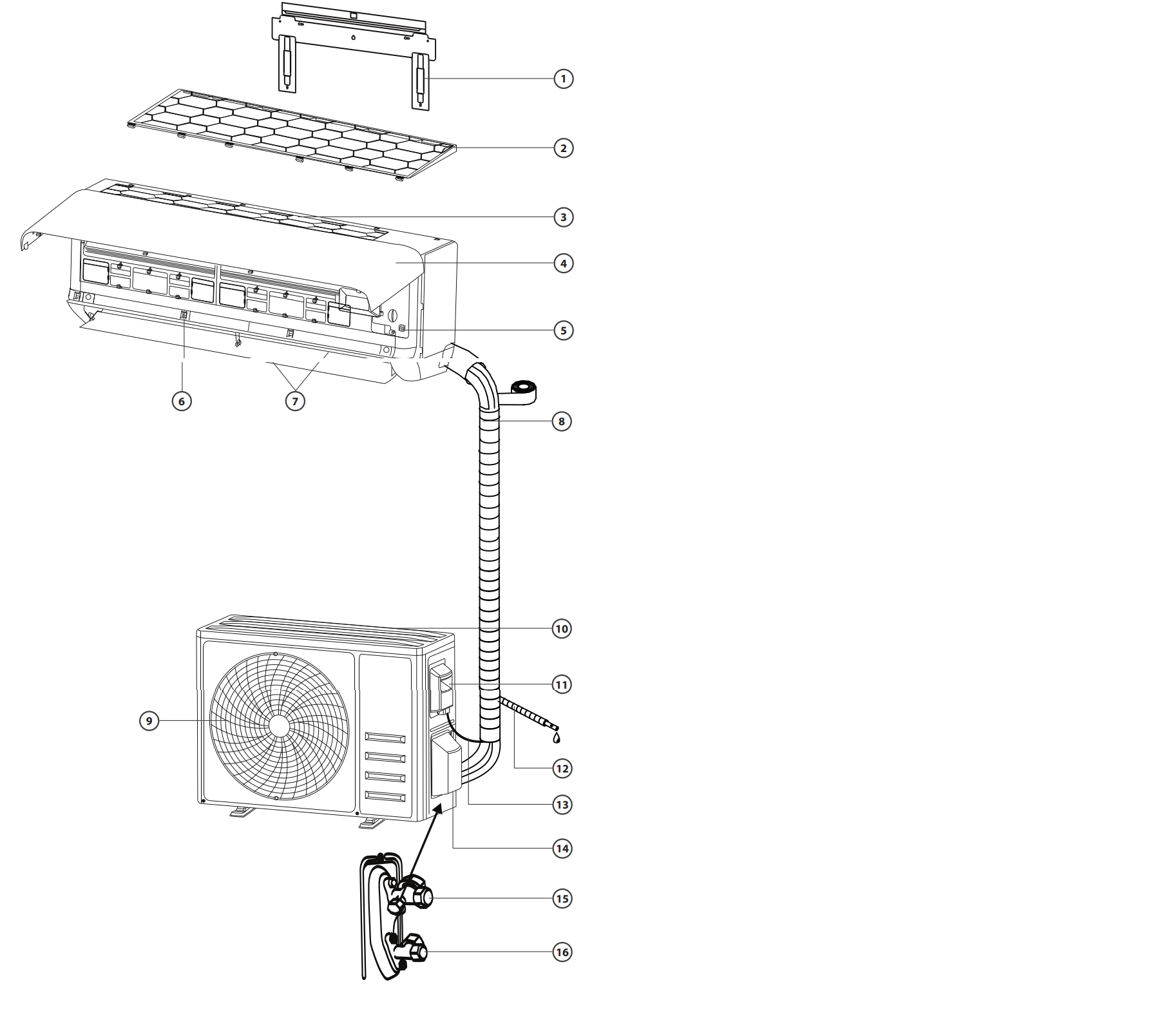
OUTDOOR UNIT
- 1) Mounting plate
- 2) Air filter
- 3) Air inlet
- 4) Front panel
- 5) Emergency button
- 6) Air outlet
- 7) Air deflector and flap
- 8) Refrigerant connecting pipe
OUTDOOR UNIT
- 9) Air outlet
- 10) Air inlet
- 11) Wiring cover
- 12) Drainage pipe
- 13) Connection wiring
- 14) Valve protective cover
- 15) Gas valve (Low pressure valve)
- 16) Liquid valve (High pressure valve)
NOTE
All the pictures in the manual are for explanation purposes only. Your unit may be slightly different. The actual shape shall prevail. The operations and functions are the same.
INDOOR UNIT DISPLAY
 SLEEP
SLEEP
SLEEP mode DISPLAY
Indicator for Timer, temperature and Error codes TIMER
TIMER
Lights up during Timer operation
EMERGENCY BUTTON
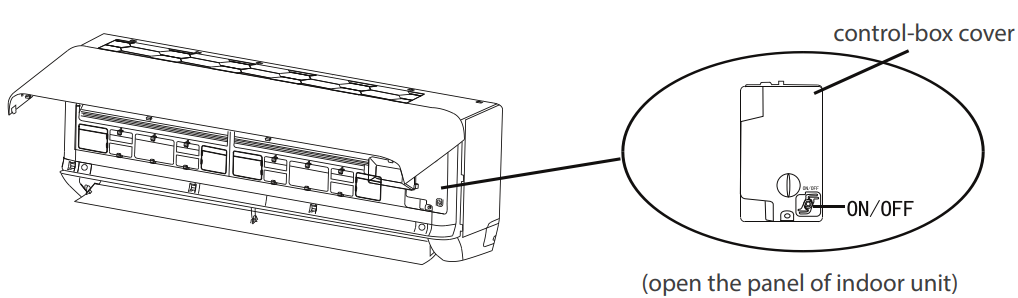
Open the panel and find the emergency button on the electronic control box when the remote controller fails.
(Always press the emergency button with insulation material.)
| Current Status | Operation | Response | Entered Mode |
|---|---|---|---|
| Standby | Press the emergency button once | It beeps briefly once | Cooling mode |
| Standby (Only for heating pump) | Press the emergency button twice in 3 seconds | It beeps briefly twice | Heating mode |
| Running | Press the emergency button once | It keeps beeping for a while | Off mode |
OPERATING TEMPERATURE
| Operating Mode | Temperature Type | Range |
|---|---|---|
| Cooling | Room Temperature | 16°C ~ 32°C |
| Cooling | Outdoor Temperature | -15°C ~ 53°C |
| Heating | Room Temperature | 0°C ~ 30°C |
| Heating | Outdoor Temperature | -25°C ~ 30°C |
CLEANING AND MAINTENANCE
WARNING
- When cleaning, you must shut down the machine and cut off the power supply for more than 5 minutes.
- Under no circumstances should the air conditioner be flushed with water.
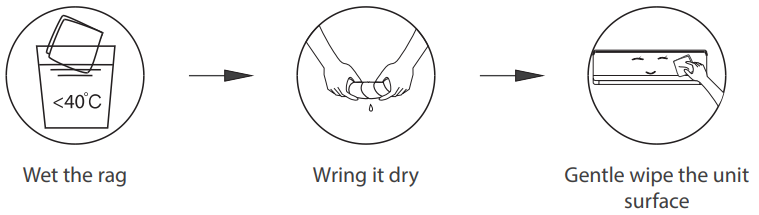
- Volatile liquid (e.g. thinner or gasoline) will damage the air conditioner, so only use soft dry cloth or wet cloth dipped with neutral detergent to clean the air conditioner.
- Pay attention to cleaning the filter screen regularly to avoid dust covering which will affect the filter screen effect. When the operating environment is dusty, the cleaning frequency should be increased appropriately.
- After removing the filter screen, do not touch the fins of the indoor unit to avoid scratching
CLEAN THE UNIT
TIP: Wipe frequently to keep air conditioner clean and good appearance
DISASSEMBLY AND ASSEMBLY OF FILTER
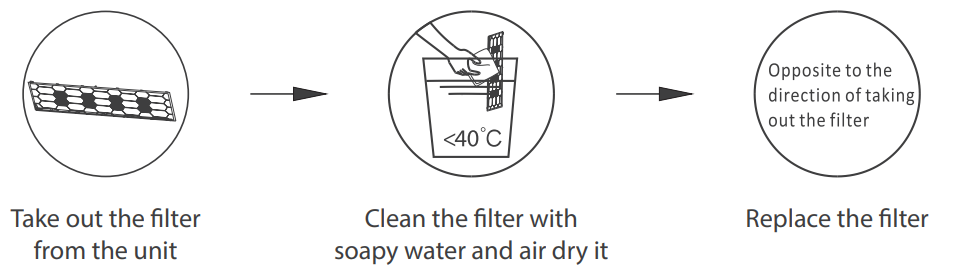
- Grasp the raised handle on the filter by hand, and then pull the filter out in the direction deviating from the unit, so that the upper edge of the filter is separated from the unit. The filter can be removed by lifting the filter upwards.
- When installing the filter, first insert the lower end of the filter screen into the corresponding position of the unit, and then squeeze the upper end of the filter into the corresponding buckling position of the nit body.

CLEAN THE FILTER
TIP: When you find accumulated dust in the filter, please clean the filter in time to ensure the clean, healthy and efficient operation inside the air conditioner.
CLEANING OF INNER AIR DUCT
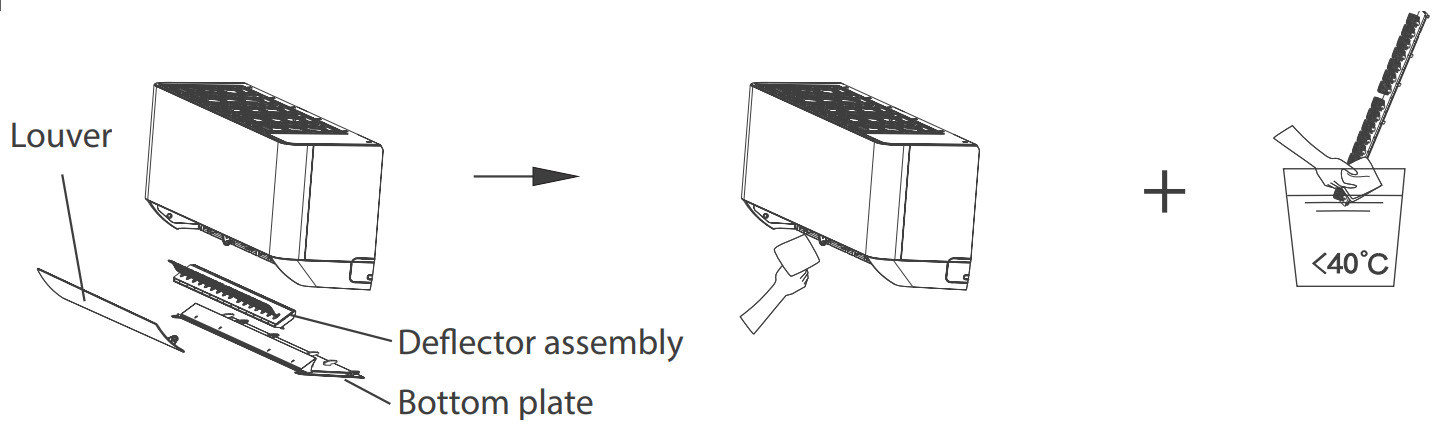
- First, loosen the knob on the middle of louver and bend the louver outwards to take it out.
- Then, grasp both sides of bottom plate push downwards to take down the bottom plate.
- Finally, loosen the buckle of deflector assembly with your thumb and take it out. Wipe the air duct and fan assembly with a clean and wrung wet rag.
- Clean the removed parts with soapy water and air dry it. After cleaning, restore the removed parts in turn.
SERVICE AND MAINTENANCE
- When the air conditioner is not in use for a long time, do the following work:
- Take out the batteries of the remote controller and disconnect the power supply of the air conditioner.
- When starting to use after long-term shutdown:
- Clean the unit and filter screen;
- Check whether there are obstacles at the air inlet and outlet of indoor and outdoor units;
- Check whether the drain pipe is unobstructed;
Install the batteries of the remote controller and check whether the power is on.
TROUBLESHOOTING
MALFUNCTIONS
| Malfunction | Possible Causes |
|---|---|
| The appliance does not operate | Power failure or plug pulled out |
| Damaged indoor/outdoor unit fan motor | |
| Faulty compressor thermomagnetic circuit breaker | |
| Faulty protective device or fuses | |
| Loose connections or plug pulled out | |
| The appliance sometimes stops operating to protect itself | |
| Voltage higher or lower than the normal range | |
| Active TIMER-ON function | |
| Damaged electronic control board | |
| Strange odour | Dirty air filter |
| Noise of running water | Backflow of liquid in the refrigerant circulation |
| A fine mist comes from the air outlet | Occurs when the air in the room becomes very cold, for example in COOLING or DRY mode |
| A strange noise can be heard | Expansion or contraction of the front panel due to temperature variations; not a fault |
| Insufficient air flow, either hot or cold | Unsuitable temperature setting |
| Obstructed air conditioner intakes and outlets | |
| Dirty air filter | |
| Fan speed set at minimum | |
| Other heat sources in the room | |
| No refrigerant | |
| The appliance does not respond to commands | Remote control not close enough to indoor unit |
| Remote control batteries need replacement | |
| Obstacles between remote control and signal receiver | |
| The display is off | Active DISPLAY function |
| Power failure | |
| Switch off the air conditioner immediately and cut off the power supply in the event of | Strange noises during operation |
| Faulty electronic control board | |
| Faulty fuses or switches | |
| Spraying water or objects inside the appliance | |
| Overheated cables or plugs | |
| Very strong smells coming from the appliance |
ERROR CODE ON THE DISPLAY
| CODE | Description of the Trouble |
|---|---|
| E1 | Indoor room temperature sensor fault |
| E2 | Indoor pipe temperature sensor fault |
| E3 | Outdoor pipe temperature sensor fault |
| E4 | Refrigerant system leakage or fault |
| E6 | Malfunction of indoor fan motor |
| E7 | Outdoor ambient temperature sensor fault |
| E0 | Indoor and outdoor communication fault |
| E8 | Outdoor discharge temperature sensor fault |
| E9 | Outdoor IPM module fault |
| EA | Outdoor current detect fault |
| EE | Outdoor PCB EEPROM fault |
| EH | Outdoor fan motor fault |
| EF | Outdoor suction temperature sensor fault |
APPENDIX
APPENDIX FOR REFRIGERANT R290/R32
SPECIFIC INFORMATION REGARDING APPLIANCES WITH R290 / R32 REFRIGERANT GAS.
- Thoroughly read all of the warnings.
- When defrosting and cleaning the appliance, do not use any tools other than those recommended by the manufacturing company.
- The appliance must be placed in an area with- out any continuously sources of ignition (for example: open flames, gas or electrical appliances in operation).
- Do not puncture and do not burn.
- This appliance contains Y g (see rating label back of unit) of R290 / R32 refrigerant gas.
- R290 / R32 is a refrigerant gas that complies with the European directives on the environment. Do not puncture any part of the refrigerant circuit. Be aware the refrigerants may not contain an
odour. - If the appliance is installed, operated or stored in a nonventilated area, the room must be designed to prevent to the accumulation of refrigerant leaks resulting in a risk of fire or explosion due to ignition of the refrigerant caused by electric heaters, stoves, or other sources of ignition.
- The appliance must be stored in such a way as to prevent mechanical failure.
- Individuals who operate or work on the refrigerant circuit must have the appropriate certification issued by an accredited organization that ensures competence in handling refrigerants according to a specific evaluation recognized by associations in the industry.
- Repairs must be performed based on the recommendation from the manufacturing company
- Maintenance and repairs that require the assistance of other qualified personnel must be per- formed under the supervision of an individual specified in the use of flammable refrigerants.
- Appliances shall be installed ,operated and stored in a room with a floor area larger than 4 m2. The appliance shall be stored in a well ventilated area where the room size corresponds to the room area as specified for operation.
REPAIR INSTRUCTIONS FOR APPLIANCES CONTAINING R290 / R32
GENERAL INSTRUCTIONS
This instruction manual is intended for use by individuals possessing adequate backgrounds of electrical, electronic, refrigerant and mechanical experience.
- Checks to the area
Prior to beginning work on systems containing flammable refrigerants, safety checks are necessary to ensure that the risk of ignition is minimized. For repair to the refrigerating system, the following precautions shall be complied with prior to conducting work on the system. - Work procedure
Work shall be undertaken under a controlled procedure so as to minimize the risk of a flammable gas or vapour being present while the work is being performed. - General work area
All maintenance staff and others working in the local area shall be instructed on the nature of work being carried out. Work in confined spaces shall be avoided. The area around the workspace shall be sectioned off. Ensure that the conditions within the area have been made safe by control of flammable material. - Checking for presence of refrigerant
The area shall be checked with an appropriate refrigerant detector prior to and during work, to ensure the technician is aware of potentially flammable atmospheres. Ensure that the leak detection equipment being used is suitable for use with flammable refrigerants, i.e. nonsparking, adequately sealed or intrinsically safe. - Presence of fire extinguisher
lf any hotwork is to be conducted on the refrigeration equipment or any associated parts, appropriate fire extinguishing equipment shall be available to hand. Have a dry powder or CO2 fire extinguisher adjacent to the charging area. - No ignition sources
No person carrying out work in relation to a refrigeration system which involves exposing any pipe work that contains or has contained flammable refrigerant shall use any sources of ignition in such a manner that it may lead to the risk of fire or explosion. All possible ignition sources, including cigarette smoking, should be kept sufficiently far away from the site of installation, repairing, removing and disposal, during which flammable refrigerant can possibly be released to the surrounding space. Prior to work taking place, the area around the equipment is to be surveyed to make sure that there are no flammable hazards or ignition risks. “No Smoking” signs shall be displayed. - Ventilated area
Ensure that the area is in the open or that it is adequately ventilated before breaking into the system or conducting any hot work. A degree of ventilation shall continue during the period that the work is carried out. The ventilation should safely disperse any released refrigerant and preferably expel it extremally into the atmosphere. - Checks to the refrigeration equipment
Where electrical components are being changed, they shall be fit for the purpose and to the correct specification. At all times the manufacturer’s maintenance and service guidelines shall be followed. lf in doubt consult the manufacturer’s technical department for assistance. The following checks shall be applied to installations using flammable refrigerants: – the charge size is in accordance with the room size within which the refrigerant containing parts are installed;- the ventilation machinery and outlets are operating adequately and are not obstructed;
- if an indirect refrigerating circuit is being used, the secondary circuit shall be checked for the presence of refrigerant;
- marking to the equipment continues to be visible and legible. Markings and signs that are illegible shall be corrected;
- refrigeration pipe or components are installed in a position where they are unlikely to be exposed to any substance which may corrode refrigerant containing components, unless the components are constructed of materials which are inherently resistant to being corroded or are suitably protected against being so corroded.
- Checks to electrical devices
Repair and maintenance to electrical components shall include initial safety checks and component inspection procedures. lf a fault exists that could compromise safety, then no electrical supply
shall be connected to the circuit until it is satisfactorily dealt with. lf the fault cannot be corrected immediately but it is necessary to continue operation, an adequate temporary solution shall be used. This shall be reported to the owner of the equipment so all parties are advised. Initial safety checks shall include:- that capacitors are discharged: this shall be done in a safe manner to avoid possibility of sparking;
- that there no live electrical components and wiring are exposed while charging, recovering or purging the system; that there is continuity of earth bonding.
REPAIRS TO SEALED COMPONENTS
- During repairs to sealed components, all electrical supplies shall be disconnected from the equipment being worked upon prior to any removal of sealed covers, etc. lf it is absolutely necessary to have an electrical supply to equipment during servicing, then a permanently operating form of leak detection shall be located at the most critical point to warn of a potentially hazardous situation.
- Particular attention shall be paid to the following to ensure that by working on electrical components, the casing is not altered in such a way that the level of protection is affected. This shall include damage to cables, excessive number of connections, terminals not made to original specification, damage to seals, incorrect fitting of glands, etc. Ensure that apparatus is mounted securely.
Ensure that seals or sealing materials have not degraded such that they no longer serve the purpose of preventing the ingress of flammable atmospheres. Replacement parts shall be in accordance with the manufacturer’s specifications.
NOTE: The use of silicon sealant may inhibit the effectiveness of some types of leak detection equipment. Intrinsically safe components do not have to be isolated prior to working on them.
REPAIR TO INTRINSICALLY SAFE COMPONENTS
Do not apply any permanent inductive or capacitance loads to the circuit without ensuring that this will not exceed the permissible voltage and current permitted tor the equipment in use. Intrinsically safe components are the only types that can be worked on while live in the presence of a flammable atmosphere.
The test apparatus shall be at the correct rating. Replace components only with parts specified by the manufacturer. Other parts may result in the ignition of refrigerant in the atmosphere from a leak.
CABLING
Check that cabling will not be subject to wear, corrosion, excessive pressure, vibration, sharp edges or any other adverse environmental effects. The check shall also take into account the effects of aging or continual vibration from sources such as compressors or fans.
DETECTION OF FLAMMABLE REFRIGERANTS
Under no circumstances shall potential sources of ignition be used in the searching for or detection of refrigerant leaks. A halide torch (or any other detector using a naked flame} shall not be used.
LEAK DETECTION METHODS
The following leak detection methods are deemed acceptable for systems containing flammable refrigerants. Electronic leak detectors shall be used to detect flammable refrigerants, but the sensitivity may not be adequate, or may need recalibration. (Detection equipment shall be calibrated in a refrigerant-free area.) Ensure that the detector is not a potential source of ignition and is suitable for the refrigerant used. Leak detection equipment shall be set at a percentage of the LFL of the refrigerant and shall be calibrated to the refrigerant employed and the appropriate percentage of gas (25 % maximum} is confirmed.
Leak detection fluids are suitable for use with most refrigerants but the use of detergents containing chlorine shall be avoided as the chlorine may react with the refrigerant and corrode the copper pipework. If a leak is suspected, all open flames shall be removed/extinguished. If a leakage of refrigerant is found which requires brazing, all of the refrigerant shall be recovered from the system, or isolated (by means of shut off valves} in a part of the system remote from the leak. Oxygen free nitrogen (OFN) shall then be purged through the system both before and during the brazing process.
REMOVAL AND EVACUATION
When breaking into the refrigerant circuit to make repairs – or for any other purpose – conventional procedures shall be used. However, it is important that best practice is followed since flammability is a consideration. The following procedure shall be adhered to: remove refrigerant; purge the circuit with inert gas; evacuate; purge again with inert gas; open the circuit by cutting or brazing. The refrigerant charge shall be recovered into the correct recovery cylinders. The system shall be “flushed” with OFN to render the unit safe. This process may need to be repeated several times. Compressed air or oxygen shall not be used for this task.
Flushing shall be achieved by breaking the vacuum in the system with OFN and continuing to fill until the working pressure is achieved, then venting to atmosphere, and finally pulling down to a vacuum. This process shall be repeated until no refrigerant is within the system. When the final OFN charge is used, the system shall be vented down to atmospheric pressure to enable work to take place. This operation is absolutely vital if brazing operations on the pipework are to take place. Ensure that the outlet tor the vacuum pump is not close to any ignition sources and !here is ventilation available.
CHARGING PROCEDURES
In addition to conventional charging procedures, the following requirements shall be followed. Ensure that contamination of different refrigerants does not occur when using charging equipment. Hoses or lines shall be as short as possible to minimise the amount of refrigerant contained in them. Cylinders shall be kept upright. Ensure that the refrigeration system is earthed prior to charging the system with refrigerant.
Label the system when charging is complete (if not already). Extreme care shall be taken not to overfill the refrigeration system. Prior to recharging the system it shall be pressure tested with OFN. The system shall be leak tested on completion of charging but prior to commissioning. A follow up each test shall be carried out prior to leaving the site.
DECOMMISSIONING
Before carrying out this procedure, it is essential that the technician is completely familiar with the equipment and all its detail. lt is recommended good practice that all refrigerants are recovered safely. Prior to the task being carried out, an oil and refrigerant sample shall be taken in case analysis is required prior to re-use of reclaimed refrigerant. lt is essential that 4 GB electrical power is available before the task is commenced.
- Become familiar with the equipment and its operation.
- Isolate system electrically.
- Before attempting the procedure ensure that:
- HANDLING equipment is available, if required, for handling refrigerant cylinders;
- All personal protective equipment is available and being used correctly; the recovery process is supervised at all times by competent person;
- recovery equipment and cylinders conform to the appropriate standards.
- Pump down refrigerant system, if possible.
- lf a vacuum is not possible, make a manifold so that refrigerant can be removed from various parts of the system.
- Make sure that cylinder is situated on the scales before recovery takes place.
- Start the recovery machine and operate in accordance with manufacturer’s instructions.
- Do not overfill cylinders. (No more than 80 % volume liquid charge).
- Do not exceed the maximum working pressure of the cylinder, even temporarily.
- When the cylinders have been filled correctly and the process completed, make sure that the cylinders and the equipment are removed from site promptly and all isolation valves on the equipment are closed off.
- Recovered refrigerant shall not be charged into another refrigeration system unless it has been cleaned and checked.
LABELLING
Equipment shall be labelled stating that it has been decommissioned and emptied of refrigerant. The label shall be dated and signed. Ensure that there are labels on the equipment stating
he equipment contains flammable refrigerant.
RECOVERY
When removing refrigerant from a system, either for servicing or decommissioning, il is recommended good practice that all refrigerants are removed safely. When transferring refrigerant into cylinders, ensure that only appropriate refrigerant recovery cylinders are employed. Ensure that the correct number of cylinders for holding the total system charge are available. All cylinders to be used are designated for the recovered refrigerant and labelled for that refrigerant (i.e. special cylinders for the recovery of refrigerant).
Cylinders shall be complete with pressure relief valve and associated shut-off valves in good working order. Empty recovery cylinders are evacuated and, if possible, cooled before recovery occurs. The recovery equipment shall be in good working order with a set of instructions concerning the equipment that is at hand and shall be suitable for the recovery of flammable refrigerants. In addition, a set of calibrated weighing scales shall be available and in good working order. Hoses shall be complete with leak-free disconnect couplings and in good condition.
Before using the recovery machine, check that is in satisfactory working order, has been properly maintained and that any associated electrical components are sealed to prevent ignition in the event of a refrigerant release. Consult manufacturer if in doubt. The recovered refrigerant shall be returned to the refrigerant supplier in the correct recovery cylinder, and the relevant Waste Transfer Note arranged. Do not mix refrigerants in recovery units and especially not in cylinders.
If compressors or compressor oils are to be removed, ensure that they have been evacuated to an acceptable level to make certain that flammable refrigerant does not remain within the lubricant. The evacuation process shall be carried out prior to returning the compressor to the suppliers. Only electric healing to the compressor body shall be employed to accelerate this process. When oil is drained from a system, shall be carried out safely.
Frequently Asked Questions
What is the cooling capacity of the Rotenso TA26Xi R17?
- The TA26Xi R17 is designed for efficient cooling and heating in small to medium-sized rooms with inverter-based temperature control.
Does the Rotenso TA26Xi R17 support heating mode?
- Yes. The unit provides both cooling and heating functions for year-round comfort.
Which refrigerant does the unit use?
- The system uses R32 refrigerant for improved efficiency and lower environmental impact.
Is the Rotenso TA26Xi R17 energy efficient?
- Yes. The inverter compressor technology helps reduce energy consumption while maintaining stable room temperature.
Can I control the unit with a remote?
- Yes. The system includes a wireless remote controller with multiple operating modes and timer settings.
What should I do if an error code appears?
- Refer to the troubleshooting and error code section in the user manual or contact an authorized service technician.
Download This User Manuals Guide Here!
Rotenso TA26Xi R17 Series Room Air Conditioner User Manual
